Quick Navigation: Explore the Depths
- Why Are Tsunami Dreams So Common and So Scary?
- How to Deconstruct Your Tsunami Dream: A Step-by-Step Guide
- Common Tsunami Dream Scenarios and Their Potential Meanings
- Deeper Dives: Psychological and Spiritual Perspectives
- "Okay, I'm Freaked Out. What Do I Do Now?" Practical Steps After the Dream
- Frequently Asked Questions About Tsunami Dream Meaning
Let's be honest, waking up from a dream where a giant wall of water is bearing down on you is a genuinely awful way to start the day. Your heart is pounding, you might even feel a bit breathless, and that unsettling image sticks with you for hours. You're not alone in searching for the tsunami dream meaning. It's one of those powerful, visceral dreams that sends people straight to Google, looking for answers.
I've talked to so many people about their tsunami dreams over the years. A friend of mine, a project manager, had them for weeks before a major product launch. He was standing on a cliff, watching the wave come in, feeling completely frozen. Another person described being in their childhood home, seeing the water rise through the windows. The details vary wildly, but the core feeling—of overwhelming, unstoppable force—is almost always the same.
So, what's your subconscious trying to tell you with this dramatic, often terrifying, imagery? Is it a simple warning sign, a deep spiritual message, or just random brain noise? The truth is, pinning down a single, universal tsunami dream meaning is a fool's errand. Dream interpretation is deeply personal. But we can map the territory, explore the common themes psychologists and cultures have identified, and give you a practical toolkit to figure out what your dream means for you.
This isn't about giving you a one-size-fits-all fortune cookie message. It's about helping you understand the language of your own mind.
Why Are Tsunami Dreams So Common and So Scary?
Think about it. In the dream world, our fears and anxieties don't usually show up as spreadsheets or polite emails. They manifest as monsters, chases, falling... and natural disasters. A tsunami is a perfect metaphor for the kind of stress that feels beyond our control.
It's not a problem you can reason with or negotiate with. You can't build a wall high enough. It's a force of nature, immense, impersonal, and utterly devastating. This is why the tsunami dream meaning often points to emotional overwhelm. It's your psyche's way of screaming, "I'm in over my head!"
From a purely biological standpoint, dreaming about threats allows our brain to practice responses in a safe space. But a tsunami is a different kind of threat practice. It's not fighting a single enemy; it's dealing with a cataclysm.
I think part of the reason we're all so familiar with this dream symbol now is media. We've all seen the footage from real tsunamis—the 2004 Indian Ocean disaster or the 2011 Tōhoku event in Japan. Those images are seared into our collective consciousness. Our dreaming brain reaches for the most powerful symbol of uncontrollable force it can find, and that's often a tsunami.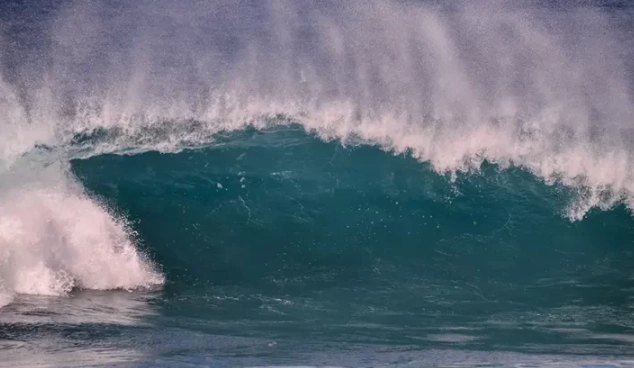
How to Deconstruct Your Tsunami Dream: A Step-by-Step Guide
Forget those cheap online dream dictionaries that just say "tsunami = fear." That's useless. To get at the real tsunami dream meaning for you, you need to be a detective. Here's how I recommend breaking it down.
Step 1: Recall and Record the Details
As soon as you wake up, grab your phone or a notebook. Don't just think "had a tsunami dream." Write down everything. Where were you? On a beach, in a city, on a boat? Were you alone or with people? What did the water look like? Dark and oily, or clear and blue? Could you see the wave coming from afar, or did it just appear suddenly? These details are the clues. A tsunami dream meaning changes drastically if you're a passive observer versus actively trying to outrun it.
Step 2: Analyze Your Emotional Response In the Dream
This is the most important part. What were you feeling during the dream? This is different from the fear you feel upon waking. Were you terrified? Strangely calm? Resigned to your fate? Were you trying to warn others? Maybe you felt a sense of awe at the power of the wave. Your emotional reaction is the direct signal from your subconscious about how you're really handling a situation in your waking life. Panic suggests you feel helpless. Calmness might indicate dissociation or a sense of fatalism. Action-oriented feelings (running, warning) point to a fighting spirit, even if the threat is huge.
This is the key. The feeling is the message.
Step 3: Connect to Your Waking Life
Now, play a matching game. Look at your current life. Where do you feel a sense of impending, unstoppable pressure? It rarely has to do with actual water. Is it a workload that keeps piling up? A relationship conflict that feels like it's about to explode? A financial worry that's growing? A health scare? A big life change (like a move, career shift, or having a child) that feels like it will wash away your old life? The tsunami dream meaning is almost always a reflection of these psychic pressures.
Common Tsunami Dream Scenarios and Their Potential Meanings
While every dream is personal, patterns emerge. Here’s a look at some frequent scenes and what they might point towards. Use this as a starting point for reflection, not a definitive answer.
| Dream Scenario | Common Emotions in the Dream | Potential Tsunami Dream Meaning & Waking-Life Connection |
|---|---|---|
| Seeing the tsunami from a distance. You're on high ground, watching the wave approach the shore or a city. | Dread, anxiety, helplessness, morbid curiosity. | You see a problem developing in your life or for someone close to you, but you feel powerless to stop it. You're in the position of an observer, perhaps anticipating a crisis at work or in your family that you can't prevent. |
| Running from the tsunami. You're on the ground, actively trying to escape the wave. | Pure panic, urgency, desperation, survival instinct. | You are directly in the path of an overwhelming situation and are in "fight or flight" mode. This is the classic anxiety dream, where you feel actively pursued by stress, deadlines, or obligations. The act of running shows you haven't given up. |
| Being caught in the tsunami. The wave hits you, you're tumbling underwater, struggling to breathe. | Overwhelm, suffocation, disorientation, loss of control. | You feel you are currently "drowning" in your emotions or responsibilities. The crisis isn't coming; it's here. You may feel like you're barely keeping your head above water in a relationship, job, or dealing with grief. |
| Surviving the tsunami. You make it through the wave, find yourself in the aftermath, wet but alive. | Shock, relief, sadness, surveying the damage. | This can indicate you've recently been through a major emotional upheaval (a breakup, job loss, big argument) and are now in the recovery phase. You're assessing what's left, what's broken, and what you need to rebuild. It's a dream of resilience. |
| Dreaming of a tsunami warning with no wave. You hear sirens, see alerts, but the tsunami never arrives. | Anxious anticipation, vigilance, confusion. | You're living in a state of constant high alert, expecting a disaster that hasn't materialized. This could link to health anxiety, financial worry, or relationship insecurity where you're always waiting for the other shoe to drop. |
A quick personal gripe: I find some spiritual interpretations that only see tsunamis as "positive cleansing" to be a bit dismissive. Sure, that angle exists, but telling someone who just had a terrifying dream that it's just about "washing away the old" can feel invalidating. The emotional truth of the dreamer comes first.
Deeper Dives: Psychological and Spiritual Perspectives
To really broaden our understanding of tsunami dream meaning, it helps to look through different lenses.
The Psychological Lens (Mostly Carl Jung)
Carl Jung, the famous Swiss psychiatrist, saw dreams as messages from the unconscious, trying to balance our conscious mind. In his framework, water often represents the unconscious itself—deep, mysterious, and full of potential life and danger.
A tsunami, then, could symbolize a massive uprising of unconscious content. Stuff you've repressed—old wounds, ignored talents, powerful emotions—might be threatening to break into your conscious awareness. It's not necessarily "bad," but it is forceful and disruptive because you've been ignoring it for too long. The C.G. Jung Institute of Philadelphia has resources that delve into archetypal symbols like this, though they caution against overly simplistic interpretations.
From a more modern cognitive perspective, it's simply your brain's way of processing extreme stress. The American Psychological Association discusses how dreams can help with emotional regulation, sometimes by simulating threatening scenarios. So, your tsunami dream might be a kind of pressure valve for your anxiety.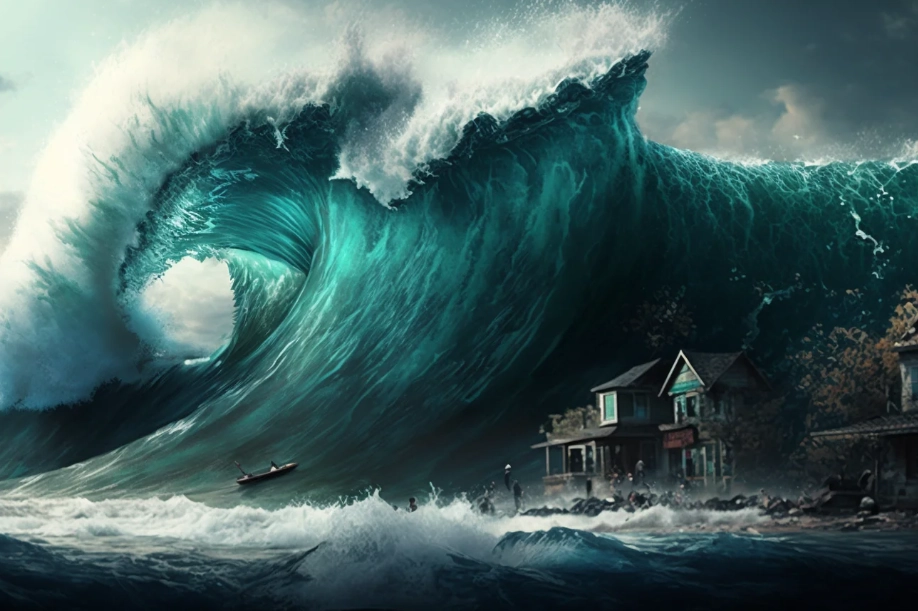
The Spiritual and Cultural Lens
Many spiritual traditions view water as a symbol of emotion, intuition, and cleansing. A tsunami dream meaning in this context could be about a necessary, if violent, emotional purge. An old pattern, belief, or relationship needs to be utterly washed away to make space for something new. It's a forced rebirth.
In some cultures, dreaming of natural disasters is seen as a sign from ancestors or the spirit world. I'm not an expert here, and I'd be wary of anyone claiming definitive spiritual answers. But it's worth acknowledging this perspective exists, especially if you come from a tradition that values such dream messages.
Personally, I find the psychological explanations more grounded and useful for taking action in daily life. But the spiritual angle can offer a sense of larger purpose or meaning in the midst of chaos, which some people find comforting.
"Okay, I'm Freaked Out. What Do I Do Now?" Practical Steps After the Dream
Understanding the potential tsunami dream meaning is one thing. Dealing with the lingering anxiety is another. Here's a practical list, things you can actually do:
- Don't Ignore It. The dream is a signal. Treat it like a check-engine light for your mind. Take 15 minutes to journal using the steps above.
- Identify the Source. Try to name the "wave" in your life. Is it Project X at work? The tension with Person Y? The uncertainty about Z? Just naming it reduces its nebulous, terrifying power.
- Break It Down. A tsunami is one massive wave, but you can't tackle massive waves. What is one small, concrete action you can take to address a part of that stress? Send one email. Have one 10-minute conversation. Make one list. Action is the antidote to helplessness.
- Practice Grounding. If the dream felt particularly real, do grounding exercises when you wake up. Name 5 things you see, 4 things you feel, 3 things you hear, 2 things you smell, 1 thing you taste. It brings you back to the present, safe reality.
- Talk About It. Tell a trusted friend, "I had this intense dream, and it's making me realize I'm really stressed about..." Saying it out loud is powerful.

Frequently Asked Questions About Tsunami Dream Meaning
Let's tackle some of the specific questions people type into search engines. You know, the real nitty-gritty.

Look, at the end of the day, you are the ultimate expert on your own tsunami dream meaning. All the guides, tables, and psychological theories are just maps. You have to walk the territory of your own life.
That dream, as frightening as it was, is a form of communication. It's a part of you trying to get a message through. The worst thing you can do is shake it off and say, "That was weird," and move on. The best thing you can do is to sit with it for a moment, ask it questions, and see what connections your mind makes. Often, the very act of seriously asking "What is this tsunami in my life?" starts to calm the waters.
Because once you see the wave for what it represents—a project, a fear, a change—it stops being just a monster in the night. It becomes a problem you can start to manage, piece by piece, on dry land, in the light of day.











Comments
Join the Conversation