Explore the Journey
- The Universal Symbol: Why Bridges Speak to Everyone
- Crossing Cultures: The Bridge in World Mythology and Religion
- Bridges in Your Dreams: What Your Subconscious is Trying to Cross
- The Bridge as a Metaphor for Personal Growth and Spiritual Journey
- Answering Your Questions: The Spiritual Meaning of the Bridge, Demystified
- Bringing It Home: Finding Bridges in Your Everyday Life
You see them every day. Driving over them, walking across them, maybe even ignoring them as just part of the scenery. A bridge is just a way to get from point A to point B, right? A practical solution to a geographic problem. But what if I told you that every time you cross one, you're participating in one of humanity's oldest and most profound spiritual metaphors? That's the real question we're diving into today: what is the spiritual meaning of the bridge?
It's not just about architecture. It's about connection, transition, and the scary, exciting space between who you are and who you might become. I remember standing on a rickety old footbridge in the woods as a kid, terrified to move. It wasn't the height—it was the feeling of being suspended between two solid, safe banks. That feeling never really left me. It shows up in life all the time. Changing careers, ending a relationship, starting a family, forgiving someone… they all feel like crossing a bridge where you can't quite see the other side.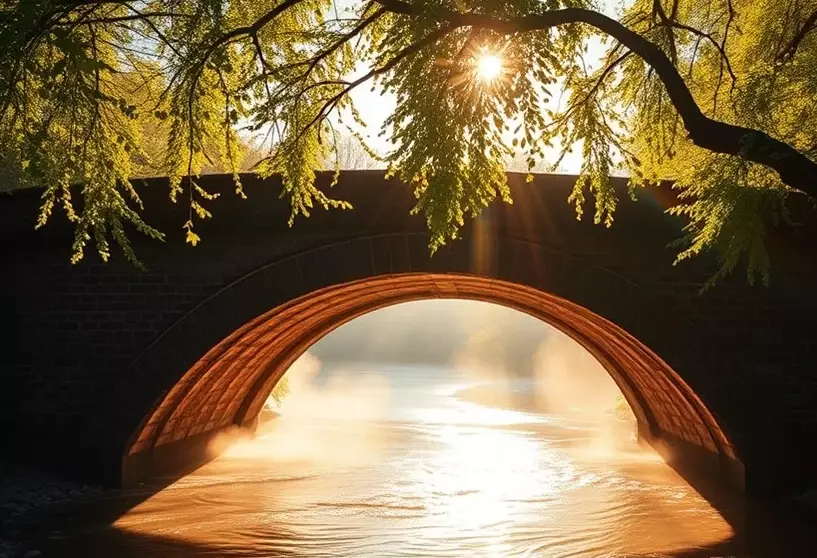
Let's get one thing straight. A lot of spiritual talk can get fluffy and vague. "The bridge connects your soul to the universe." Okay, but what does that actually mean for someone feeling stuck, grieving, or on the verge of a big decision? That's what we're here for. We're going to break down this symbol into something you can actually use. We'll look at it from every angle: ancient myths, world religions, your dreams, and the messy reality of your personal growth.
The Universal Symbol: Why Bridges Speak to Everyone
Think about it. Before engineering, before cities, humans looked at rivers and chasms and dreamed of crossing them. That desire is primal. The bridge became an early and powerful symbol because it solved a fundamental human problem: separation. This idea is embedded in our collective psyche. Carl Jung, the famous psychologist, would call the bridge an archetype—a universal symbol that pops up across all cultures and times because it represents a shared human experience.
So, what are the core ingredients of this symbol?
- The Two Sides: This is the starting point. You have a here and a there. The known and the unknown. Your current situation and your desired goal. Your past and your future. Your conscious mind and your subconscious. The bridge needs these two distinct points to have any meaning at all.
- The Gap or Obstacle: Between the two sides is something that prevents an easy crossing. Water (emotions, the unconscious), a valley (a low point, a challenge), or a road (the path of others, societal expectations). The obstacle defines the journey.
- The Structure Itself: The bridge is the means, the method, the decision to cross. It's not the starting point or the destination. It's the active process of moving from one to the other. It requires effort, intention, and often, courage.

This three-part structure makes it a perfect metaphor for any kind of change or spiritual progress. You're on one bank. You want to be on the other. Something is in the way. You must build or find a way across. Simple, yet endlessly deep. When you start looking for this pattern, you see it everywhere—in stories, movies, and most importantly, in the milestones of your own life.
Crossing Cultures: The Bridge in World Mythology and Religion
If you want proof that the spiritual meaning of the bridge is a universal concept, just travel through world beliefs. Every culture has its own version, and comparing them reveals some fascinating common threads and unique twists.
Then you have the Islamic concept of As-Sirāt. This is the hair-thin, sharper-than-a-sword bridge that every soul must cross after death. It stretches over the fires of Hell. Your fate determines how you cross: the righteous sprint across, others crawl painfully, and the wicked fall. Here, the bridge isn't just a transition; it's the ultimate test and judgment. The Encyclopedia Britannica notes the significance of such eschatological symbols across Abrahamic faiths, highlighting their role in moral cosmology.
Buddhism offers a gentler but no less profound view. The concept of the Buddha or the Dharma as a bridge is central. The teachings are the bridge that carries beings from the shore of suffering (samsara) to the shore of liberation and enlightenment (nirvana). It's a bridge you must walk yourself; no one can carry you. The Access to Insight library, a trusted resource for Theravada Buddhist texts, frequently uses this imagery in translations and commentaries.
In Chinese tradition, bridges are often seen as connectors of not just land, but of qi (energy flow) and community. They feature prominently in Feng Shui to channel positive energy and connect separated areas. Folk tales are full of bridges where spirits and humans meet, like the Magpie Bridge formed by birds so the Weaver Girl and Cowherd can reunite once a year. This turns the bridge into a symbol of love overcoming separation, sanctioned by the natural world itself.
| Culture/Religion | Bridge Name/Concept | Core Spiritual Meaning |
|---|---|---|
| Norse Mythology | Bifröst (Rainbow Bridge) | Connection between realms (Gods & Humans), fragility, destiny. |
| Islam | As-Sirāt | Post-death judgment, test of faith and deeds, transition to afterlife. |
| Buddhism | The Dharma (Teachings) | Path from suffering to enlightenment, personal journey, practical wisdom. |
| Chinese Tradition | Magpie Bridge, Feng Shui Bridges | Love reuniting, connection of energy (qi), harmony between nature and human affairs. |
| Celtic Lore | Fairy Bridges, Natural Stone Arches | Thresholds to the Otherworld, places of magic and danger, respect for liminal spaces. |
Looking at this table, a pattern emerges. The bridge is almost always a liminal space—a threshold place that is neither here nor there. These spaces are powerful, sacred, and often dangerous. They are where transformation happens, for better or worse. This is why so many cultures place guardians (like Heimdall), tests (like As-Sirāt), or rituals at their bridges. You don't just casually wander across; you pass through with intention.
My personal take? The Norse one always felt a bit bleak to me—a bridge doomed to break. I'm more drawn to the Buddhist idea. The bridge as teachings, as a practical guide you can actually follow. It feels less like a cosmic test and more like a tool you're given. But that's just me. The Islamic version certainly packs a motivational punch for living a good life!
Bridges in Your Dreams: What Your Subconscious is Trying to Cross
This is where the spiritual meaning of the bridge gets personal. Dreams are the language of your subconscious, and bridges show up all the time. Dream interpreters have been analyzing these symbols for centuries. But modern psychology, drawing from the work of folks like Jung, sees them as reflections of your inner state.
So, you dream of a bridge. What's the first question to ask yourself? What does the bridge look like, and how do I feel on it? The details are everything.
Let's break down the stages of crossing your own personal bridge. It's rarely a smooth walk in the park.
1. Recognizing the Divide (The Two Banks)
This is the awareness stage. You feel a disconnect. Maybe it's between your current job and your sense of purpose. Between a habit that numbs you and the vitality you crave. Between an old grudge and the peace you want. This is the uncomfortable but necessary first step: seeing that there is a gap you can no longer ignore. You're standing on one bank, looking at the other. This stage is all about honest assessment.
2. Assessing the Gap and Gathering Materials
What's in the way? Is it a river of fear? A canyon of low self-worth? A busy highway of other people's opinions? You need to understand the obstacle before you can build across it. This is the research, the introspection, the seeking of advice or tools. In spiritual terms, these "materials" might be meditation practices, therapy, journaling, community support, or new knowledge. You can't cross if you don't know what you're facing.
3. The Act of Crossing (The Walk Itself)
This is the action phase—the scary part. It's leaving the old job, having the hard conversation, starting the new practice, practicing forgiveness. The bridge might sway. You might get dizzy. You'll probably look back longingly at the solid, familiar bank you left. This is where courage isn't the absence of fear, but the decision that what's on the other side is more important than your fear. Progress here is often slow, step-by-step.
4. Integration on the Other Side
You've crossed! But you don't just arrive and pretend the old bank never existed. You integrate the journey. You learn from what the crossing taught you. You solidify the new ground you're standing on. This might mean establishing new routines, owning your new identity, or simply allowing yourself to feel the relief and new perspective. Sometimes, you might even look back and realize you need to burn that bridge behind you to fully commit to the new place. Other times, you keep it as a reminder of where you came from.
I think a lot of spiritual bypassing happens when people try to teleport to the other side without building or walking the bridge. They want the peace without the forgiveness work, the confidence without facing the fears, the enlightenment without the daily practice. It doesn't work. The bridge is the non-negotiable middle part. It's the work. And honestly, sometimes the work feels tedious, scary, or lonely. That's okay. That's part of the meaning.
Answering Your Questions: The Spiritual Meaning of the Bridge, Demystified
Let's get practical and tackle some of the specific questions people have when they search for this topic. These are the real-world curiosities and confusions.
This is a beautiful concept. To be a bridge means to use your own presence, compassion, or resources to help someone else cross a difficult gap in their life. You're not carrying them. You're not their destination. You're offering stable, supportive ground so they can find their own footing and make the crossing themselves. A mentor, a therapist, a supportive friend during grief—they are all acting as bridges. The key is that a good bridge is stable but doesn't create dependency. It empowers the other person to walk their own path.
Not always, but often. More precisely, it's about connection or the potential for transition. It could symbolize connecting two ideas, connecting with another person, or connecting different parts of yourself. The "change" might be internal—like integrating a shadow aspect of your personality. Always look at the context of the dream and your waking life feelings.
Great question. A path implies a longer, ground-level journey through a landscape. A spiral suggests cyclical growth, returning to similar lessons at higher levels. A ladder implies a more vertical, hierarchical ascent, often with rungs of achievement. A bridge is specifically about spanning a clear divide. It highlights the before-and-after, the separation and the specific act of overcoming it. It's more focused on the threshold moment itself.
Absolutely. A bridge can symbolize a connection you shouldn't make or a dangerous dependency. A "bridge to nowhere" can represent wasted effort or a false promise. A bridge that's a trap or leads to a prison symbolizes a choice that led to confinement, not freedom. Context is king. The bridge is a structure; its moral or emotional value depends entirely on where it leads, why you're crossing, and what you're leaving behind.
These questions get to the heart of why people search for this topic. They're not just looking for a dictionary definition. They're trying to interpret a dream that unsettled them, understand a feeling of being "in between," or find language for their own role in helping others. That's the real need.
Bringing It Home: Finding Bridges in Your Everyday Life
So, we've talked theory, mythology, and psychology. Let's get concrete. Where are the bridges in your life right now? Not the physical ones, but the spiritual and psychological ones.
Maybe it's the bridge between waking up and starting your day with intention—that's a small but powerful daily crossing. Maybe it's the bridge between feeling angry at a loved one and choosing to communicate with compassion. Maybe it's the massive, daunting bridge from a career that pays the bills to one that feeds your soul. Or the delicate, painful bridge from grief to a life that holds the memory but keeps living.
The point is to start seeing them. To name them. "Oh, this difficult conversation I'm avoiding… that's a bridge I need to cross." "This new meditation habit I'm trying to build is the bridge to a calmer mind."
Understanding the spiritual meaning of the bridge won't make the crossings easy. Fear of heights is still fear of heights. But it can make them meaningful. It can remind you that the dizziness, the sway, the looking back, are all part of the process of moving from one state of being to another. It's the architecture of change.
Next time you physically cross a bridge, take a second. Feel your feet on the surface. Look at the space beneath you. You're in a liminal zone, a powerful in-between. You're practicing, in a small way, the ancient art of crossing over. And that's something worth remembering.
Because in the end, the question "what is the spiritual meaning of the bridge?" is really a question about how we navigate the most important journeys of our lives. It's not an abstract symbol. It's a blueprint for courage, a map for transition, and a reminder that connection—between places, people, or parts of ourselves—always requires us to build something and then take the first step.



Comments
Join the Conversation